


Table Of Contents
Description
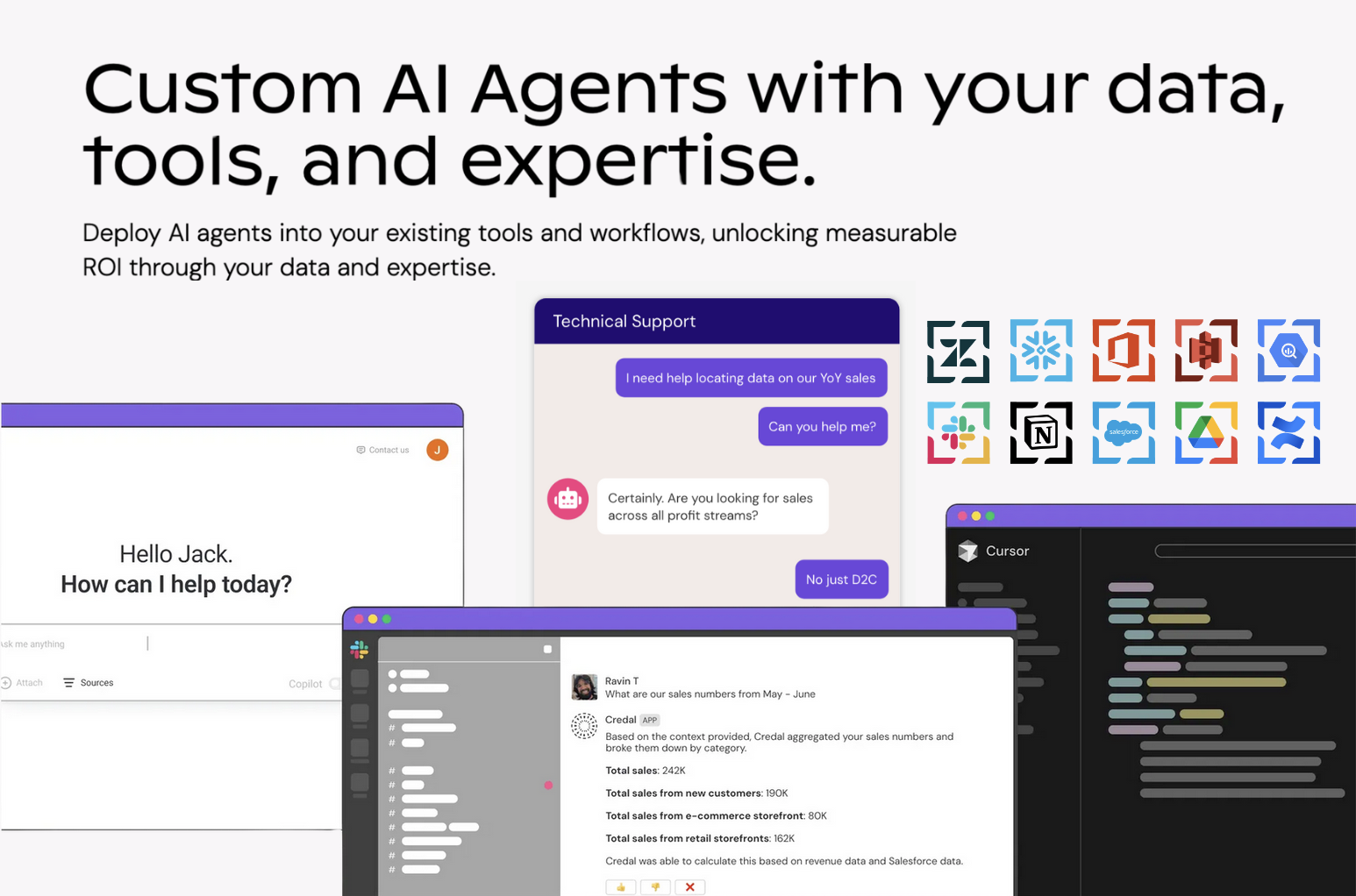
Credal is a secure AI agent platform that lets enterprises build retrieval-augmented generation apps and deploy permission-aware agents across systems like Slack, Salesforce, and Confluence. It syncs content and access controls in real time, stores vectors in a SOC 2-certified index, and supports configurable embedding models and search logic. Developers use REST APIs to trigger actions like message handling and document search, with built-in PII redaction that masks sensitive data before LLM calls and restores it in final outputs. CIO, security, and application teams use Credal to safely deploy GenAI copilots without exposing sensitive IP.
Customers
What Problem Does Credal Solve?
Enterprises lose time and efficiency as employees search across fragmented systems like Slack, Salesforce, and Confluence, often handling routine tasks manually. This results in slower decision-making, duplicated effort, and elevated compliance risk. Credal addresses this by deploying AI agents that can retrieve, summarize, and act on company data in real time—while enforcing existing access controls, protecting sensitive content, and reducing operational overhead.
Pros
- Granular Access Controls:
Credal provides fine-grained permissions for AI models and datasets, ensuring role-based access and compliance across teams. - Enterprise-Ready Data Governance:
Enables secure, auditable use of AI by tracking data lineage, enforcing usage policies, and aligning with internal governance frameworks. - Seamless AI Integration:
Connects easily to foundation models and internal data sources, allowing controlled AI use without compromising proprietary information.
Cons
- Integration Overhead:
Connecting diverse internal systems and data sources may require custom setup and IT involvement, increasing deployment time. - Model Scope Constraints:
The platform’s control layers may restrict experimentation or rapid iteration with newer, unapproved AI models. - Adoption Curve for Non-Technical Teams:
Policy configuration and permission management may present a learning curve for business users without IT support.
Investors
Last updated: September 14, 2025
All research and content is powered by people, with help from AI.