


Table Of Contents
Description
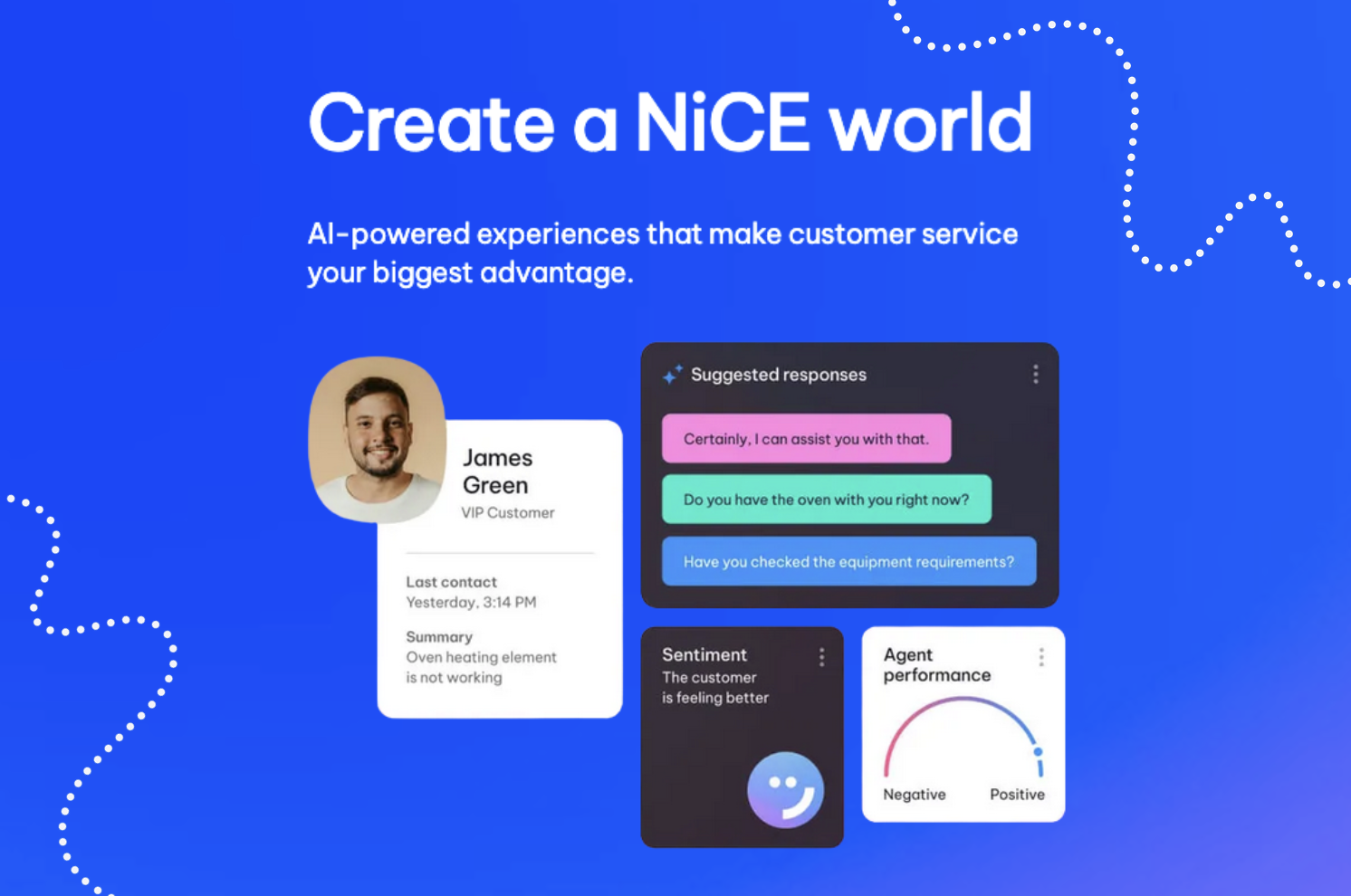
NiCE provides enterprise cloud platforms that use AI to manage complex interactions across two key domains: customer experience and financial crime. For customer engagement, its CXone platform orchestrates omnichannel service using AI-powered virtual agents and agent-assist copilots that integrate with enterprise CRMs. In parallel, its financial crime and compliance solutions help institutions manage risk by leveraging AI for real-time fraud detection, anti-money laundering (AML) monitoring, and trade surveillance. Both platforms are designed to help large, regulated enterprises automate processes, ensure compliance, and analyze massive volumes of interaction data.
Customers
What Problem Does NiCE Solve?
Large enterprises struggle to manage the risk and complexity within their vast number of daily interactions, both with customers and in financial transactions. In the contact center, this leads to frustrated customers and high support costs; in finance, it results in undetected fraud and significant compliance risk. NiCE solves these problems on two fronts with its AI platforms. Its CXone solution unifies the customer journey to automate service and improve agent performance, while its financial crime platform analyzes transactions to detect and prevent fraud and money laundering, allowing enterprises to protect both their customers and their bottom line.
Pros
- Unified CX Platform:
Delivers a solution combining AI-powered contact center workflows, copilots, automation, and analytics to improve agent and customer experiences. - Omnichannel Support Automation:
Offers intelligent virtual agents and orchestrated interaction across voice, chat, email, and social media platforms. - Financial Crime Prevention:
Provides deep domain expertise and proven AI models for anti-money laundering (AML), fraud detection, and trade surveillance. - Advanced Workforce Management:
Integrates AI-enhanced scheduling, performance monitoring, and knowledge management to boost agent productivity and service consistency.
Cons
- Enterprise Integration Complexity:
Implementing deep integrations across CRM, ticketing, and voice systems can be resource-intensive and require cross-functional coordination. - Governance and Security Demands:
Ensuring compliance and secure role-based access across CX workflows necessitates robust policy control and certified data-handling. - License Tier Variability:
Differentiated feature availability across editions may lead to unpredictable costs and complexity when scaling services or adding modules.
Last updated: July 25, 2025
All research and content is powered by people, with help from AI.