You can’t rely on Claude or any other LLM provider to provide granular enterprise security and governance. Here’s how to do it in Barndoor.
When enterprises deploy AI agents, it’s tempting to rely on the governance controls built into each platform. For example, Claude’s admin controls and audit logging. OpenAI’s policy layer. Custom agents and whatever the team that built them configured.
These controls are bad, but they generally stop at the edge of each platform. If you’re a single AI house, that’s okay but most enterprises today run multiple agents or agentic platforms concurrently. Across knowledge workers alone, Barndoor research found that over 58% of employees say they use at least 2-3 different AI tools for work; 7% use 4-6 tools. Maybe it’s ChatGPT for general tasks, or Claude for sensitive work, or Gemini because it’s integrated into Google Workspace, and then GitHub Copilot inside dev environments. Each connection carries its own exposure risk, operates under different terms of service, and most likely none of them are being tracked.
Security permissions in Claude don’t carry over to other AI models
Even if you have strong permissions set up in Claude, they don’t carry over to your OpenAI or other deployments. Audit logs from one system don’t talk to logs from another. When an agent takes an action you didn’t expect, there’s no organization-wide way to pause activity while you investigate. Also, because access is typically granted at the MCP connector or plugin level, not at the action or data level, security teams have limited ability to enforce least-privilege principles across agentic workflows.
Governing a multi-agent enterprise
Governing a heterogeneous multi-agent enterprise is a different problem. Large AI models and LLMs like Claude or OpenAI were designed to operate within their own ecosystems. Security and IT teams deploying agentic AI need four things that these solutions can’t provide:
Unified visibility. A single view of what every agent is doing, what data it’s touching, and what actions it’s taken, regardless of which platform it’s running on.
Cross-platform policy enforcement. The ability to define access controls, data handling rules, and behavioral guardrails once, and have them apply consistently across Claude, OpenAI, custom agents, and every other tool in the stack.
Fine-grained permissions. Access evaluated at the action and data level, not just at the connector level. Knowing and being able to control the difference between “this agent can access Salesforce” and “this agent can read contact records but cannot export or delete them” can make a big difference around controlled deployments.
A way to pause agent activities enterprise-wide. When something goes wrong (and in agent workflows, something eventually will) teams need the ability to pause or block agent activity across the entire organization instantly, not platform by platform.
A governance layer built for multi-agent environments
Barndoor isn’t another AI model. It’s the enterprise control plane that sits between all of your AI agents, agentic platforms and your enterprise applications and MCP connectors. Barndoor gives IT and security teams the oversight they need within these multi-agent environments.
Barndoor provides comprehensive audit logging and dashboards across every user, agent, and MCP interaction. It enforces fine-grained role based and attribute based policies with deep identity provider integration, regardless of which AI platform is executing the work.
It complements every AI platform rather than replacing any of them. Claude remains excellent at what it was designed to do. Barndoor ensures the enterprise controls exist around it, and around every other agent running alongside it.
Setting policies for Claude in Barndoor
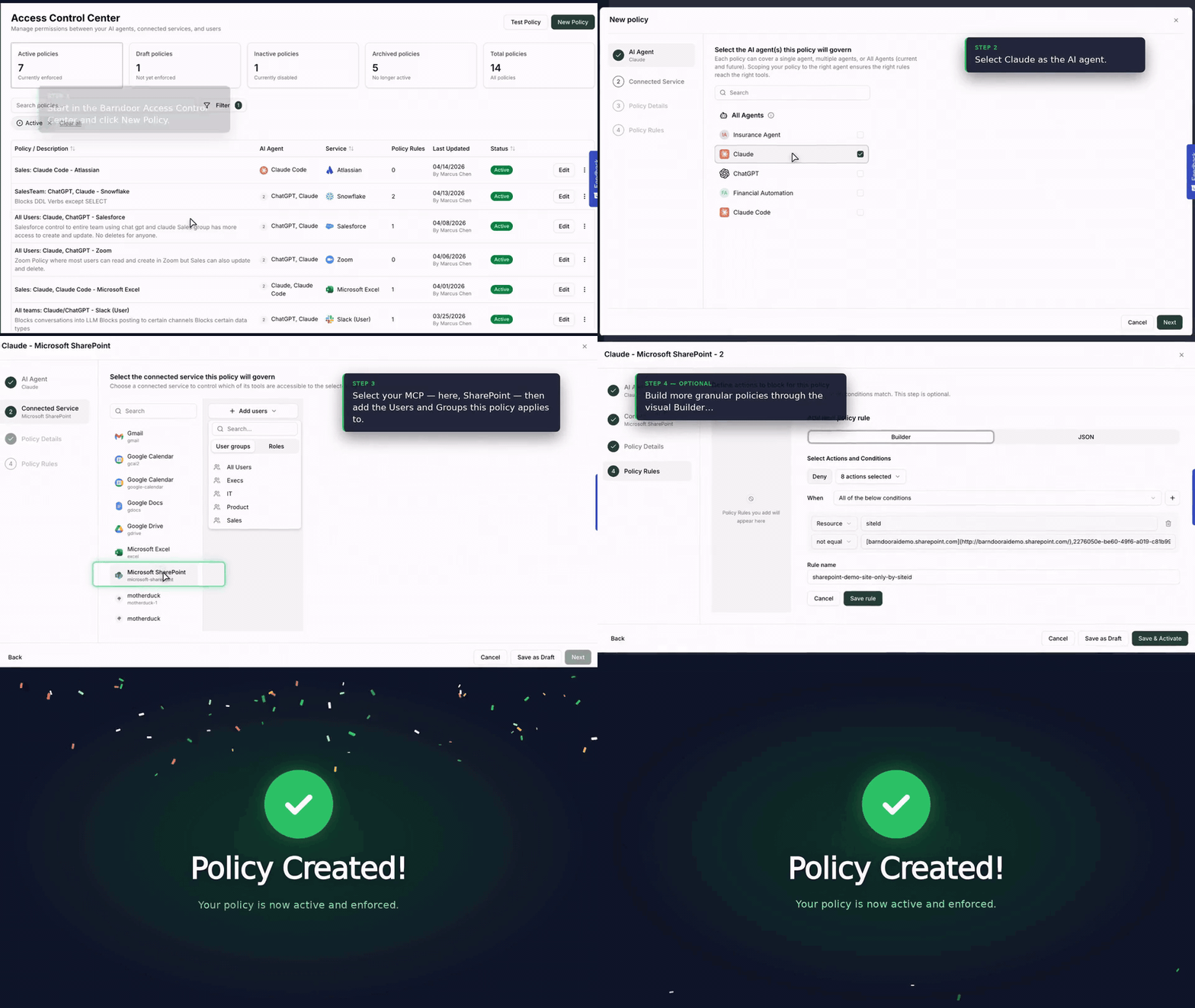
Building and managing access policies and permissions across your AI models is easy through the Barndoor platform – IT security can draft and test policies, manage full policy inventory from one view, and trace every allow or deny decision back to the policy that triggered it. For instructions on how to configure Claude with Barndoor to manage your employees’ MCP access, visit Barndoor documentation.
The opportunity to get this done right is here
AI agent adoption inside enterprises is accelerating. Your ability to move fast with AI depends on your ability to establish a governance foundation today. Don’t wait – you risk spending the next two years retrofitting controls onto an environment that grew without them in the first place.
Book a demo or start a free trial to see how the Barndoor platform enables you to establish multi-agent policies.
Setting up policies for Claude Enterprise