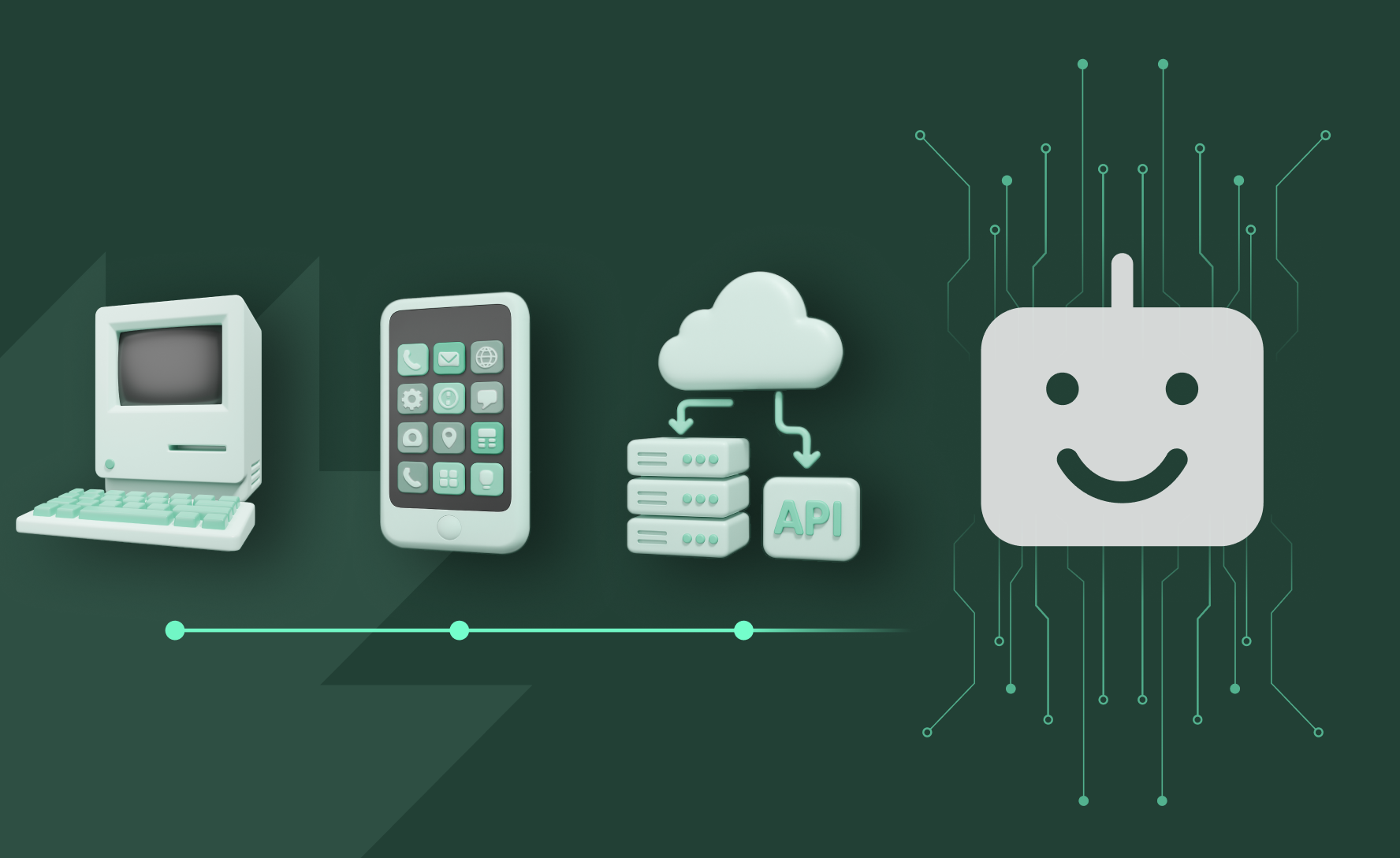
Big technology changes are tough on business, because they have to forget a lot of what they thought was true, and learn new rules that aren’t yet clear. I’ve been looking at this effect for several years, and I’ve learned that if you watch behavior, you’ll learn about the new sources of value.
Technology Shifts and Human Behavior
This is based on a little-noted tech reality: Nobody ever bought a computer so they could have a beige box blinking in their closet. They didn’t pay out for a smartphone so there’d be a weird bulge in their suitcoat, or a satellite dish for a futuristic weathervane. And in the Age of AI, they won’t buy agents to learn new acronyms and have autonomous software scrambling all over their companies.
Tech is about new experiences that border on the magical. Building and accessing the Internet, downloading a thousand delights through smartphone apps, and witnessing a thousand channels from your living room. It’s still early days in the case of agentic systems, but right now the experience people are after is augmenting the human workforce to discover new things and deliver more value.
Lessons from Past Tech Waves
How do we find out what that magical experience will look like? Behavior. What people do is key to figuring out the experience they’re after.
It’s no simple thing. Steve Jobs released the iPhone, but didn’t at first realize that a large number of apps, developed by people everywhere, would be what made his smartphone an iconic global product. At first Jobs tried limiting the iPhone to a handful of apps made and controlled in-house. It was only after people started “jailbreaking” their phones en masse to download third-party apps. That was the key behavior. To Jobs’ credit, he took note and opened up the App Store.
I’ve seen many such changing corporate behaviors in response to tech. I was early in APIs, a once-unthinkable exposure of corporate data, which enabled the explosion of mobile apps. I worked on the early commercialization of WiFi, a technology that talented engineers worked on for free (talk about a notable behavior) for the sake of Internet everywhere. I witnessed the first days of Uber, and saw how, thanks to cloud computing, a small startup could build out mapping, billing, social functions, and machine learning, for a single-digit percentage of what it would have cost them just to buy servers. Uber’s use of the cloud was an early standard for the new startup behavior.
Behavior Driving Agentic AI and MCP Adoption
So far, what are the strong signals around agentic systems? Initial fascination with LLMs, of course, was an early breakthrough. On its own this didn’t do much for companies but offer free content creation, though. Anthropic’s MCP protocol, which allows companies to inventory and access the tools and services of other entities, is a huge addition to the original LLM AI breakthrough. It’s having an enormous effect, some of it unplanned (it will be interesting to see what MCP does to previous corporate connectors, like glue code and service architectures.)
MCP is still too young (nine months ago it hadn’t been published) to have reliable figures on its uptake, but it’s pretty clear that lots of people are working with it, and lots of companies are exposing their tools and services on it. That’s a behavior clue. It’s notable that there are other technologies for connecting and making the work of agents more complex. These include Google’s A2A, OpenAI’s Connectors, and IBM’s ACP, also in the picture.
They may not all last, but they underline the kind of experience people are looking for – lots of capability, lots of discovery of new capabilities, and an appetite for ever more complexity, so agentic systems can explore and work within ever-larger environments.
I don’t think this means they’re going to be trained to learn every aspect of a business, and run it on nothing but robots. We’d better hope not, since it’s still people who do wonderful innovations, carefully creating even more experiences. And when robots make mistakes, they make them at scale.
What it does mean is that agentic systems will offer an experience of exploration and action – some of it for discovery, some of it for automation, and some of it to assist people in creating faster and better.
It’s going to be such a large and dynamic space that I’m spending a lot of time looking at and thinking about behavior itself, in a whole new way. Barndoor is all about the observation and management of agentic system behavior itself, including the human interaction with agents. This includes access, identity, governance, success rates, error management, cost control, and agentic systems development. It’s early days, but I’m amazed by what we’re already learning.
Watch the behavior, win the world.