The rise of AI agents and MCP servers is reshaping how consumers and businesses interact with money—from budgeting and lending to fraud prevention and compliance. Delivering these kinds of AI-driven experiences responsibly requires visibility, access control, and governance—exactly where Barndoor AI fits in.
At the heart of this evolution is Plaid, long regarded as the trusted bridge for secure access to financial data. Now, with the introduction of Plaid MCP servers, the stage is set for a new era of AI-driven financial engagement where apps can act with real-world context and intelligence.
Barndoor extends this vision, building on Plaid MCP securely and at scale. Together, Plaid and Barndoor illustrate not just what’s possible in AI-powered finance, but how it can be delivered responsibly for consumers and businesses alike.
Plaid MCP: For Developers Today
Plaid provides a Sandbox MCP server that offers helpful utilities for building and testing Plaid-powered applications. It allows developers to experiment safely, validate integrations, and explore MCP capabilities without relying on live financial data.
Plaid recently announced its Dashboard MCP server, which is a significant leap forward. It streamlines integration and gives Plaid customers and developers access to data, support, and insights through one conversational interface. Developers can optimize account linking, monitor usage metrics, and resolve connectivity issues through a simple conversation. This eliminates the need to navigate complex dashboards, remember intricate debugging steps, or wait for support tickets to be resolved.
For example, instead of digging through a dashboard, an AI app can simply make a tool call: “What was my Plaid API usage last month?” The MCP server mediates the request, fetches the data, and returns a structured response—all without exposing sensitive financial details. A recent Plaid blog illustrates how this shift enables more natural, conversational interactions with data.
New AI Possibilities
Looking ahead, the possibilities for AI in fintech are vast. With MCP providing an intelligent bridge into financial systems, enterprises can begin to imagine new applications not only for developers and internal teams, but also for their end customers. With MCP servers that include expanded tool calls, potential future use cases could include:
- AI-powered personal finance assistants that proactively optimize savings and investments.
- Real-time credit risk assessment and loan approvals using live financial data.
- Automated tax preparation pulling verified transaction histories.
- Fraud detection agents that monitor unusual account behavior in seconds.
- Dynamic budgeting tools that adapt based on spending patterns and goals.
The result: financial engagement that is faster, smarter, and more personalized than ever before.
Powerful Possibilities Demand Visibility, Security & Controls
The promise of MCP in fintech is undeniable: for consumers, it could unlock real-time, AI-driven financial engagement that goes far beyond what traditional apps could achieve. The real power emerges when this capability extends across multiple systems—where agents use different MCP servers.
For example:
- An agent uses an MCP to analyze checking and savings balances against upcoming obligations and a planned furniture purchase.
- It assembles a monthly budget in Google Sheets.
- It then shares the file via Gmail.
The agent is working across systems to deliver a seamless end-to-end experience.
For enterprises to bring these kinds of future AI experiences from concept to production, they need to manage MCP responsibly at scale—ensuring:
- Agents are governed by attribute- and role-based access control, protecting users from improper or imprecise LLM interpretations while maintaining full visibility into every MCP interaction.
- AI agents don’t overreach, accessing sensitive financial accounts they shouldn’t.
- Data is not used in ways that violate compliance or privacy mandates.
What’s required are fine-grained permissions that align with enterprise needs:
- Ensuring granular access controls down to the user, role, and action, so AI apps and agents only interact with authorized tool calls across MCP servers and systems.
- Providing full audit trails for every MCP request and action.
- Enabling dynamic policy enforcement to keep security teams in control as AI deployments scale.
How Barndoor Helps FinTech Companies Scale AI Securely
That’s exactly where Barndoor comes in. Barndoor is a centralized data and access management platform that sits between AI apps and MCP servers—including Plaid’s and secures how AI interacts with your corporate data.
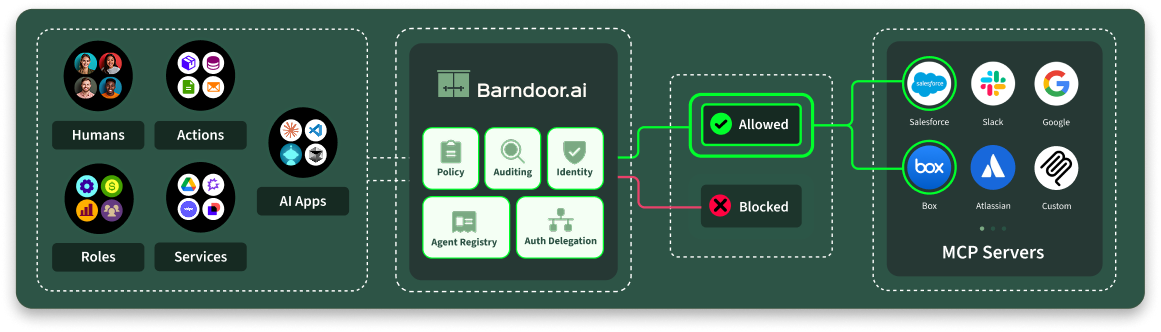
For enterprises looking to create AI-driven workflows across MCP connections, Barndoor provides:
- Visibility: Maintain a complete record of MCP tool calls, agent identity, accessed systems, and purpose—all in one place for oversight and compliance reviews.
- Access Control: Enforce policies by user, role, or app to ensure only authorized interactions with MCP servers (like Plaid’s).
- Security at Scale: Detects and blocks unsanctioned or risky requests in real time, protecting sensitive financial workflows.
- Compliance: Ensure every financial data request is logged, monitored, and auditable, meeting both regulatory and internal security standards.
And while Plaid MCP is a powerful use case, Barndoor is not limited to Plaid. The same model applies to any MCP server—whether financial, CRM, productivity, or content management. That means fintech innovators can move fast with many MCPs while knowing all their systems remain secure and compliant.
Shaping the Future of AI-Driven Finance
The real future of AI in fintech lies in multi-system workflows—where agents or AI chat apps could analyze finances and then act across connected systems to guide decisions in real time. Barndoor enables this by providing the security, visibility, and access control enterprises need to scale AI with confidence.
Plaid has opened the door to the future of fintech. Barndoor ensures that when you walk through it, you do so with confidence.